
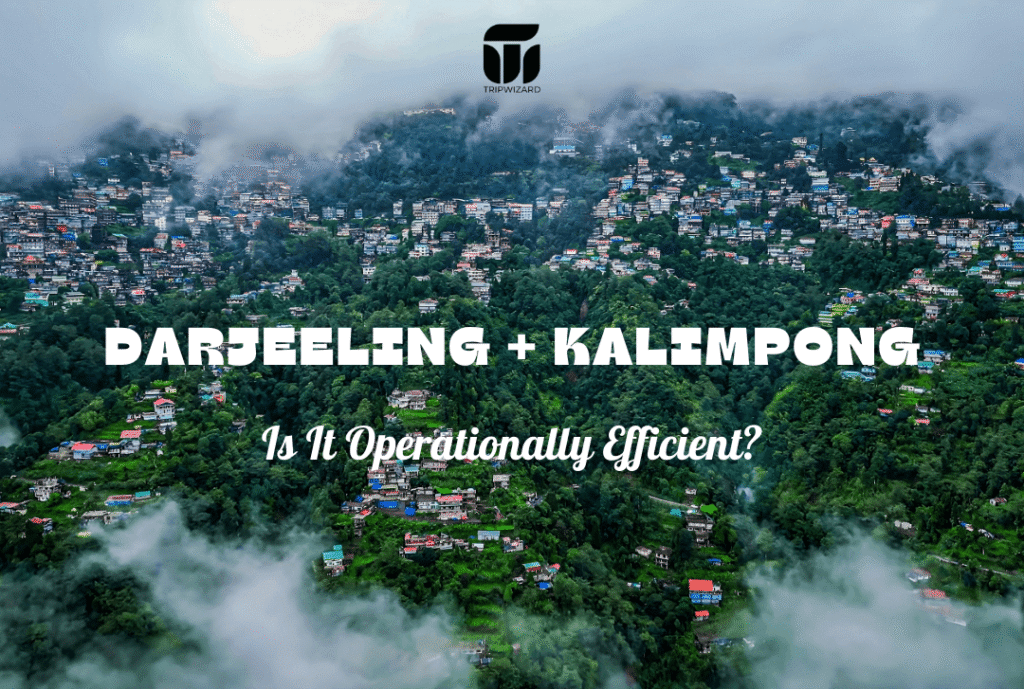
Darjeeling and Kalimpong are often sold together. On paper, it looks logical. Both are hill stations in North Bengal. The distance between them is not very large. Many operators assume combining them automatically improves the package.
But the real question is different.
Is Darjeeling + Kalimpong operationally smooth? Or does it increase movement without adding real value?
For travel operators, the answer depends on structure, duration, and client type. Let’s break it down.
Distance Looks Short, But Timing Matters
Darjeeling to Kalimpong is roughly 50 to 55 km depending on the route. It sounds easy. But hill roads are not predictable. Travel time usually ranges between 2.5 to 3.5 hours.
Add:
- Traffic near Darjeeling town
- Road bends and narrow stretches
- Weather conditions
- Occasional repair work
Now that “short transfer” may become half a day movement. If you plan sightseeing on the same day, guests feel rushed. Operationally, it is better to treat this as a proper transfer day, not a light commute.
Does Kalimpong Add Enough Value?
Darjeeling already offers:
- Tiger Hill
- Ghoom Monastery
- Batasia Loop
- Tea gardens
- Mall Road
- Himalayan views (if weather is clear)
Kalimpong offers:
- Deolo Hill
- Durpin Monastery
- Cactus Nursery
- Quiet town atmosphere
The question operators must ask is: Are these experiences very different from Darjeeling?
Kalimpong is calmer and less crowded. That is its main strength. It is more suitable for relaxed stays rather than sightseeing heavy tours. If your client wants busy sightseeing, Kalimpong may feel slow. If your client wants peaceful time, it works better. So efficiency depends on expectation.
Ideal Duration for Combining Both
Trying to combine Darjeeling + Kalimpong in 3 nights is usually inefficient.
Example of a common mistake:
2 Nights Darjeeling with 1 Night Kalimpong
This creates:
- Hotel change pressure
- Half day lost in transfer
- Limited experience in Kalimpong
A more practical structure:
4 Nights Minimum (2N Darjeeling and 2N Kalimpong)
This gives:
- Full Darjeeling sightseeing
- Relaxed transfer
- One proper day in Kalimpong
Without this duration, the combination feels forced.
Hotel Movement vs Guest Comfort
Every hotel change adds:
- Check-out time
- Luggage handling
- Room allocation delays
- Driver coordination
In hill stations, this takes longer than plains. Frequent movement reduces comfort, especially for:
- Families with kids
- Senior travellers
- Large groups
From an operational side, fewer hotel changes reduce risk. So if the client is not specifically asking for Kalimpong, keeping a longer stay in Darjeeling may actually be more efficient.
Traffic and Entry Restrictions in Darjeeling
Darjeeling town has vehicle movement restrictions in certain areas, especially near Mall Road. During peak season, traffic congestion increases significantly. Moving out to Kalimpong can reduce crowd pressure for guests. That is a positive point.
But during peak months:
- Hotel availability fluctuates
- Rates increase
- Check-in delays happen
If inventory is tight in Darjeeling, adding Kalimpong can sometimes help operationally by distributing stays. So from an inventory management angle, it can be efficient during high demand periods.
Weather Consideration
Both destinations depend on clear weather for good views. If clouds block mountain views in Darjeeling, shifting to Kalimpong does not guarantee better visibility. Weather patterns are similar. So do not position Kalimpong as a “backup for views.”
Instead, position it as:
- A quieter hill experience
- A slower pace option
- A nature focused extension
That keeps expectations realistic.
When Darjeeling + Kalimpong Works Well
This combination works best when:
- Trip duration is 4 nights or more
- Client prefers slow travel
- Family wants less crowd after Darjeeling
- Couple wants a relaxed ending
- Operator wants to balance hotel inventory
It works less effectively when:
- Total trip is only 3 nights
- Client expects fast sightseeing
- Group size is large and movement is complex
Margin and Operational Control
From a business perspective:
More movement = more coordination
More coordination = higher risk
But adding Kalimpong can:
- Increase package value perception
- Justify slightly higher pricing
- Offer hotel category variety
Many itinerary issues in hill sectors start at this exact stage of planning. This is where clarity before booking becomes critical in Darjeeling–Kalimpong combinations.
Hence, efficiency is not only about distance. It is also about how smoothly the plan runs. If structured properly, Darjeeling + Kalimpong can be operationally stable. If rushed, it becomes tiring and fragmented.
Darjeeling + Kalimpong is not automatically efficient. It becomes efficient only when:
Duration is realistic, transfer days are not overloaded, client profile matches the pace, hotel changes are minimized and expectations are clearly set
For operators, the key question should not be “Can we combine them?” It should be “Should we combine them for this client?”
When designed with logic and buffer time, the combination works smoothly. When added just to increase destinations, it reduces experience quality. In hill destinations, efficiency comes from pacing, not from adding more towns.